

This Travel Reel Called Filipino Food “The Worst.” Here’s Why That’s Dangerous
Filipino Cuisine Deserves Better Than Foreign Bloggers’ Lazy Stereotypes
By Jennifer Redondo
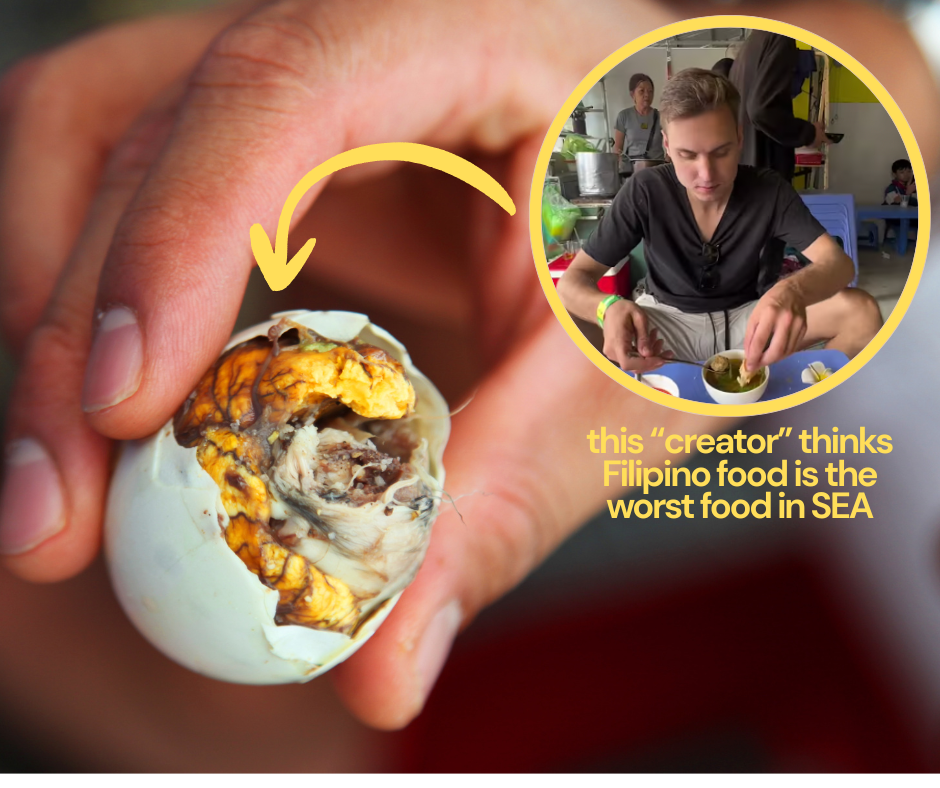
When a travel influencer decides to declare an entire country’s cuisine “the worst in Southeast Asia” to his 100k+ followers, it’s not just a hot take… it’s a red flag.
A couple months ago, @alexweldertravels posted an Instagram reel trashing Filipino food based on six reasons that range from lazy stereotypes to flat-out cultural ignorance. It’s more than just a difference in taste. It’s an example of how food criticism, when stripped of cultural context, slides into casual racism and fuels xenophobic narratives. And we’re here to unpack it because we’ve honestly had enough.
His video flashed headlines about “Why I’d rather go hungry than eat Filipino food ever again”:
The prevalence of bizarre and exotic foods.
Difficult and expensive to source fresh vegetables and meats.
Dishes are frequently drenched in oil, fried, or heavily flavored with soy sauce or sugar.
Coca-Cola is often found on tables instead of fresh fruit juices.
Meat dishes contain numerous small bones, fat, and cartilage.
The reliance on factory-produced, canned, and packet mix ingredients.
Here’s the video in question for reference.
The idea that Filipino food is the worst in Southeast Asia is a controversial opinion, but what’s more important to understand is WHY Filipino cuisine is the way that it is. It really depends on who’s speaking, their cultural background, exposure, and personal taste. Everyone is entitled to their own opinions. Though, we must dig further to understand these common reasons that people (especially outsiders) have criticized Filipino cuisine, along with some context and counterpoints to help make sense of the perception.
1. The prevalence of bizarre and exotic foods.
Filipinos are very creative and resourceful. We make do with what we have available. The food in the Philippines is so exotic, that it’s been featured on many Hollywood shows like Bizarre Foods with Andrew Zimmern and Fear Factor. On Fear Factor, contestants have the opportunity to win $50,000 USD if they consume balut, a fertilized duck egg that’s been incubated for about 18 days before it’s boiled.
Other bizarre, exotic foods that can be found in the Philippines include: dinuguan (savory stew made with pork blood, meat, and offal), chicken feet, tamilok (woodworms found in decaying mangrove trees), abuos (ant eggs harvest from the Northern Luzon mountains), betutue (deep-fried rice field frogs stuffed with minced pork), and isaw (pig or chicken intestines). These are just a few delicacies that can be found in the Philippines. A lot of these foods were created based on the region and the availability of natural resources. These are foods that have been passed down from generation to generation. It’s become a part of our culture, where we are from.
2. Difficult and expensive to source fresh vegetables and meats.
Fresh vegetables and meats are difficult and expensive to source in the Philippines due to poor transportation systems and lack of adequate refrigeration. Unlike what we are used to in the United States, refrigeration is a fairly new concept that has become available in the Philippines. Even then, not everyone can afford to buy a refrigerator. Fridges are considered a luxury because it costs a lot to buy. On top of that, the cost of electricity is also quite expensive.
The Philippines has over 7,000 islands. Since many farms are in rural areas with bad roads, it can take quite some time to travel around the islands before reaching the markets in the city. Without adequate refrigeration during transport and storage, fruits and vegetables spoil quickly. This is especially needed in the hot and humid weather in the Philippines. Unfortunately, a lot of food goes to waste due to lack of proper handling.
In addition, there are multiple middlemen, which means the price markups get passed on to the consumer. As a result, farmers are not as motivated to grow and harvest perishable crops which are riskier and less profitable. They’re more focused on survival and how to make the most so that they can take care of themselves and their families.
3. Dishes are frequently drenched in oil, fried, or heavily flavored with soy sauce or sugar.
Filipino dishes can be overly salty, sweet, or greasy for people unfamiliar with the flavor profile. Filipinos generally have a strong “sweet-savory” palate — evident in spaghetti with banana ketchup, sweet barbecue marinades, or sugar in dipping sauces. Many households develop taste profiles around ulam (savory dishes) and kanin (rice), which balance each other out.
Fried foods work well in the Philippines because oil and fried food is cheap, fast and satisfying. Oil, fried, heavily flavored foods are used to mask low-quality or preserved ingredients. Filipino dishes tend to be oily, fried, or heavily seasoned with soy sauce, sugar, or vinegar due to historical culinary fusions, climate and preservation needs, economic and practical choices, and cultural taste preference for bold, comforting flavors.
Some argue that Filipino cuisine has no clear identity. It’s a mix of Malay-Indonesian, Chinese, Spanish, American and Japanese influence. This is also what makes Filipino food unique. It’s deeply rooted in years and years of colonial history, trade and migration.
Malay-Indonesian Influence (Pre-dating colonizers): Introduced coconut-based cooking (laing, ginataang gulay, bicol express), rice cakes and sticky desserts (suman, bibingka, puto), shared use of banana leaves, fermentation, and grilled meats.
Chinese Influence (13th - 15th century): Brought soy sauce, stir-frying, noodles (pancit, mami, lomi), dumplings (siomai), buns (siopao), rice porridge (arroz caldo), and eggrolls (lumpia).
Spanish Rule (15th - 18th century): Introduced stews and braises with rich sauces (adobo, menudo, afritada, caldereta), bread (pan de sal), pastries (empanada), desserts (ensaymada, leche flan), sausages and meats (longganisa, tocino). The Philippines also adopted the Spanish mealtime structure (almuerzo, merienda).
American Colonization (1898–1946): Normalized canned and processed foods (Corned beef, Vienna sausage, Spam), frying, and condiments (ketchup, mayonnaise, peanut butter). The Americans also introduced fast-food culture to the Philippines. Hence, the creation of Jollibee, which is the Filipino version of McDonald’s. That’s where they serve burgers, fried chicken, and Filipino spaghetti with hotdogs.
Japanese Influence (post-WWII): The Japanese occupied the Philippines from 1942-1945 during World War II. Their presence left cultural traces. This can be seen in tempura-style frying (okoy) and raw fish dishes (kinilaw).
4. Coca-Cola often found on tables instead of fresh fruit juices.
You would think that fresh fruit juice would be easily available in the Philippines, but the truth is, it’s surprisingly inconvenient. Not only is it labor intensive, but it takes a lot of mangoes and calamansi to make just one glass of juice! It takes a lot of time, effort and cleaning up. In addition, it has a short shelf life and will spoil quickly without proper refrigeration. Many lower-income households don’t have reliable refrigeration, which makes storing juice impractical.
Coca-Cola is cheap, accessible and convenient. It can be purchased in every sari-sari store, market or fast food spot, even in the rural areas. Coke is already cold and ready to drink, and the bottles are recyclable. That’s why they pour coke in a plastic bag so they can keep the glass bottles for recycling.
5. Meat dishes contain numerous small bones, fat, and cartilage.
Filipino meat dishes often contain small bones, fat, and cartilage — and that’s very much by design, not accident. It reflects cultural, economic, and culinary values that prioritize full use of the animal, flavor, and practicality over Western-style "clean" cuts. Filipinos are very resourceful, and in fact, they don’t believe in wasting anything.
No part goes to waste! Filipino cuisine traditionally uses every edible part of the animal, not just the lean muscle. This includes bones, fat, cartilage, and offal (liver, intestines) which are considered delicacies not scraps! Dishes like crispy pata, bulalo, kare-kare, and batchoy rely on these parts for rich texture and deep flavor. This practice comes from a mix of indigenous values and postcolonial pragmatism — especially when prime cuts were historically unaffordable for most people.
Bones add umami. We have lots of simmered or boiled dishes that include slow-cooked bones, which release marrow and gelatin. These enrich the taste of the broths – think sinigang, nilaga. When fat is included in the dish, that means flavor! Fat is what makes the food smell and taste good – think adobo or lechon kawali.
Premium boneless cuts (like sirloin or tenderloin) are expensive and often imported or sold in high-end supermarkets. Most families buy affordable, untrimmed cuts with bones and fat — more meat for the price. Wet markets and local butchers typically sell meat as chopped-up whole sections (with bones) instead of neatly processed parts. That’s why you will find every single piece, including the cartilage included.
Filipinos are used to navigating bones and chewing cartilage. It’s part of the eating experience. Rice serves as the “neutralizer” that balances the savory meat with bits of bone or fat. In fact, bones are even communal or prized, like marrow in bulalo or crispy cartilage in sisig. You’ll often hear a Filipino saying, “that’s the best part!” If you're not used to this style of eating, it can be an adjustment, but for many Filipinos, that mix of meat, bone, and fat is what makes the dish complete.
6. The reliance on factory-produced, canned, and packet mix ingredients.
In most Filipino households, both parents work and have long commutes. With that said, Filipino food must be convenient and fast! That’s where instant seasonings, mixes, and canned goods (like Magic Sarap, Knorr cubes, Del Monte tomato sauce, or Spam) enter the chat! Dishes like menudo, afritada, or kaldereta are easier to prepare with canned tomato sauce or ready-made spice packets.
Filipino food must be affordable and have maximum shelf life stability. Processed products are cheap, accessible, and last longer than fresh alternatives, which is crucial in a tropical country with widespread poverty and limited refrigeration in some areas. Items like canned sardines, corned beef, and instant noodles provide affordable meals. All of this can be found at sari-sari stores and are available in small sachets, making them affordable even in tiny amounts.
The influence of colonialism and global brands have left a lasting impact on Filipino cuisine. Multinational companies like Nestlé, Unilever, and Del Monte heavily marketed to Filipino consumers post-WWII. Products like Milo, Knorr cubes, and Del Monte tomato sauce have shaped modern Filipino cooking habits and local taste expectations.
What started as survival and convenience has become part of the flavor DNA of modern Filipino cuisine. Many iconic Filipino dishes depend on these ingredients for their expected taste such as spaghetti with banana ketchup + hotdogs, mechado or afritada with canned Del Monte tomato sauce, and giniling with canned peas and carrots. These aren't seen as shortcuts, they’re considered standard practice.
Filipino food may not be love at first sight. Don’t let the visual appeal discourage you from giving it a taste. For example, Filipino dishes like dinuguan (pork blood stew) or paksiw na pata (braised pork hock in vinegar and soy) are both a brownish color. They are far from Instagrammable. For the most part, Filipino dishes prioritize flavor over presentation.
More and more foreigners are discovering Filipino cuisine as it’s finally having its moment as Filipino food is gaining international attention. Filipino chefs around the world are James Beard winners and restaurants like Kasama are Michelin star rated. Jollibee is expanding globally, and is becoming known as one of the top fast food, fried chicken. There are shows on Netflix like Street Food that feature Filipino chefs and dishes. Mainstream groceries and brands are incorporating Filipino flavors like ube into their top-selling products. It seems to be that Filipino food is not as loved by others because it hasn’t quite received the same exposure and approachability like other Asian foods that folks around the world are more familiar with such as Chinese, Thai and Japanese cuisines.
Alex's Instagram reel holds some truth: healthy, fresh food is often expensive and inaccessible in the Philippines. This has led Filipinos to adopt a diet high in fat, salt, sugar, and processed foods, contributing to the prevalence of diseases like gout, diabetes, and heart disease — a topic that warrants a dedicated discussion.
Written by Jennifer Redondo
Co-Founder and Co-Author of In Her Purpose




















When the Avengers: Doomsday one-year countdown dropped, audiences didn’t just watch. They paused, replayed, shared, and even speculated about hidden messages. A week later, the clip surpassed 14 million views, becoming a viral moment picked up across major media outlets that fueled anticipation for the next chapter of the Marvel Universe.
The countdown video was the result of a collaborative effort led by AGBO and its studio partners. Supporting the marketing team as a contracted editor was Joshua Ortiz (@joshuajortiz), a Filipino American filmmaker whose career has steadily built toward opportunities to contribute to projects of this scale, alongside earlier success with the short films he has written and directed.